


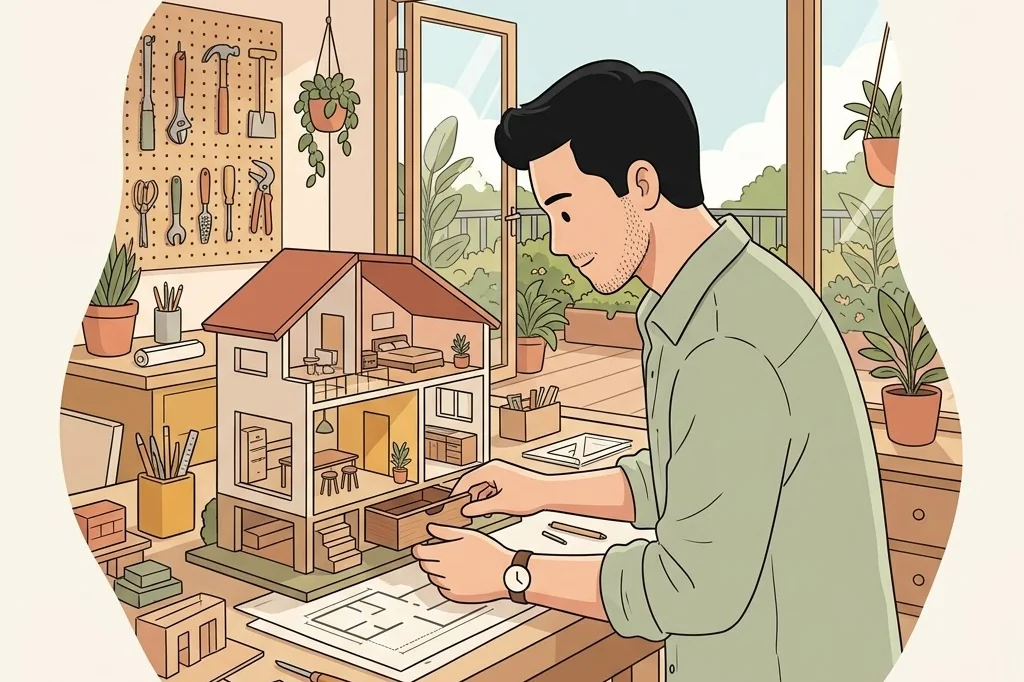
When you first learn the method of loci, your childhood home and current apartment provide more than enough capacity. However, as your learning ambitions expand into full academic disciplines, multi-volume encyclopedic knowledge, or extensive professional certifications, physical space becomes a hard constraint. You eventually run out of familiar childhood rooms. Overcoming this physical ceiling requires scaling memory palaces through modern cognitive architectural techniques.
By leveraging synthetic 3D environments, video game maps, and nested micro-rooms, you can expand your mental storage capacity infinitely. You do not need to move into a historic mansion to gain hundreds of fresh loci; you simply need to engineer virtual spaces that exploit your spatial cognition. At EZ Upskill, we teach learners how to scale their cognitive systems to absorb dense, high-volume subjects with architectural precision.
Key Takeaways
Advanced strategies for scaling your mental palace network:
- Overcome real-world spatial limits by incorporating virtual environments, video game maps, and digital museum tours.
- Deploy the nested palace technique to insert high-density sub-rooms inside ordinary furniture drawers or decorative wall art.
- Structure massive knowledge domains across multi-wing architectural hubs connected by themed transit corridors.
- Maintain spatial fidelity by exploring virtual spaces from a first-person perspective rather than an isometric or top-down view.
- Combine spatial scaling with structured maintenance protocols to protect older palaces from associative decay.
The Physical Real Estate Ceiling
Every practitioner of the method of loci memory palace encounters the real estate problem. If your apartment holds 30 reliable loci, and your office holds another 25, you quickly deplete your immediate spatial inventory after memorizing two or three technical subjects. Beginners often respond by attempting to cram multiple unrelated topics into the same living room, which leads to severe associative ghosting.
The solution is not to walk around your city desperately memorizing new cafe layouts. Instead, realize that your hippocampus does not differentiate between a physical building visited in person and a high-immersion digital space navigated in virtual reality or 3D simulation. Cognitive research published in Frontiers in Psychology highlights that virtual environments activate identical spatial navigation and place-cell firing patterns as physical environments, provided the visual cues remain stable and navigable from a first-person perspective.
Once you accept virtual spaces as legitimate cognitive real estate, your available capacity becomes virtually limitless.
Constructing Virtual Architecture and Digital Worlds
Virtual architecture provides an inexhaustible supply of structured, pristine spaces. To build a robust virtual palace, tap into existing digital environments where spatial geography is deliberately designed for effortless navigation:
1. 3D Video Game Environments
Video games spend millions of dollars engineering intuitive, memorable level designs with distinct visual landmarks, lighting contrasts, and atmospheric boundaries. Games with detailed first-person exploration, role-playing titles, and sandbox building games offer hundreds of rooms, castles, courtyards, and dungeons. If you have spent fifty hours exploring a digital game city, that city already exists as an established neural network in your brain.
2. Digital Museum and Architectural Tours
Many world-class museums, historic cathedrals, and architectural wonders offer immersive digital walkthroughs. You can walk through the Louvre, the British Museum, or Frank Lloyd Wright residences at your own pace. Because these buildings are specifically crafted to organize exhibits without cognitive chaos, they provide ideal templates for academic and technical storage.
3. Custom 3D Floor Plan Software
For custom technical domains, you can design purpose-built floor plans using simple 3D home design software. Create symmetrical wings, designate specialized lighting, and place tailored furniture precisely where you need storage waypoints. This bespoke design allows you to match room layouts directly to the logical flow of memory palaces for complex data.
The Nested Palace Technique (Micro-Palaces)
What if you want to expand an existing physical room without adding new floor space? Enter the nested palace technique, often called Russian doll architecture or fractal loci. This method allows you to embed entire multi-station micro-palaces inside a single locus of an existing room.
Here is how to engineer a nested micro-palace:
- The Portal Locus: Identify a locus in your macro-room that possesses natural depth. A grandfather clock, a wooden writing desk with small drawers, an ornate wardrobe, or a framed landscape painting serves as an ideal portal.
- The Zoom-In Mechanism: When your mental avatar arrives at the portal, visualize yourself shrinking down to miniature scale or stepping directly through the threshold. If the locus is an antique wardrobe, open the door to reveal a vast, independent Victorian library inside.
- The Sub-Route Navigation: Navigate the newly revealed interior space following standard perimeter rules, storing 10 to 20 detailed sub-concepts.
- The Zoom-Out Return: Once the sub-route is traversed, step back through the wardrobe door, return to normal scale, and continue along the perimeter of the parent room to the next primary locus.
By nesting micro-palaces inside five primary furniture pieces of a single living room, you expand that room’s capacity from five stations to over fifty stations without creating visual overcrowding.
Multi-Wing Organization and Categorical Hubs
When organizing knowledge that spans several distinct disciplines, you need a macro-level directory structure. Treat your mental architecture like a corporate headquarters or a university campus with specialized departments.
Construct a central Grand Atrium or Rotunda that acts as your main navigation hub. From this central rotunda, multiple themed corridors branch out toward dedicated wings:
- The North Wing (System Architecture): Heavy concrete walls and clean minimalist glass offices dedicated to software engineering, cloud infrastructure, and network protocols.
- The East Wing (Finance & Markets): Polished marble floors, dark mahogany tables, and bronze chandeliers storing financial models, valuation formulas, and regulatory policies.
- The South Wing (Cognitive Science & Philosophy): Warm wood paneling, floor-to-ceiling bookshelves, and cozy reading nooks housing epistemology, learning models, and mental heuristics.
This macro-wing strategy allows for seamless cross-domain skill transfer, enabling you to step out of one specialized domain corridor, traverse the central hub, and immediately cross-reference ideas in an adjacent wing.
Preventing Spatial Interference at Scale
As your palace network grows to hundreds or thousands of loci, the primary risk shifts from capacity shortages to spatial interference. If your virtual rooms share identical white walls and generic lighting, your brain will struggle to distinguish Room 14 from Room 22.
Incorporate deliberate atmospheric differentiators across every scaled environment:
- Distinct Lighting Conditions: Give one wing cool morning daylight filtering through floor-to-ceiling windows, another warm candlelight at dusk, and a third crisp industrial fluorescent lighting.
- Acoustic Signatures: Introduce subtle background soundscapes. The finance wing might feature the faint ticking of an antique grandfather clock, while the maritime history room carries the sound of rain tapping against a glass skylight.
- Tactile Flooring Shifts: Change the ground texture from cold flagstone to thick plush Persian rugs or creaky hardwood planks.
To keep vast palace networks functional over years of use, combine these atmospheric anchors with ongoing reviews outlined in our manual on permanent memory palace maintenance.
Frequently Asked Questions
Can I invent a completely imaginary room from thin air?
While possible, purely imaginary spaces require substantial cognitive effort to maintain. Your brain has to render wall textures, lighting, and proportions while simultaneously encoding data. Using existing virtual spaces (such as video games or 3D floor plans) is far more efficient because the visual details are already established.
How deep can I nest micro-palaces inside one another?
Stick to a single level of nesting for best results (Macro Room → Micro Locus → Sub-Room). Attempting to nest three or four layers deep (a room inside a drawer inside a box inside a painting) causes disorientation and makes rapid retrieval unnecessarily sluggish.
How do I keep track of all my different palaces?
Maintain an external master ledger. A simple notebook, digital document, or spreadsheet listing each palace name, subject, and total station count acts as your cognitive table of contents, ensuring no wing is forgotten.
Do virtual palaces stick in memory as well as real-life childhood homes?
With sufficient first-person navigation, virtual palaces achieve parity with real-world spaces. The key is active exploration: walking through the virtual space repeatedly rather than just viewing static photographs.
Scaling your memory palaces transforms mental storage from a constrained personal hobby into a high-capacity knowledge management system. By embracing virtual architecture, nested portals, and themed hubs, you build a mental empire capable of housing any subject you choose to conquer.