


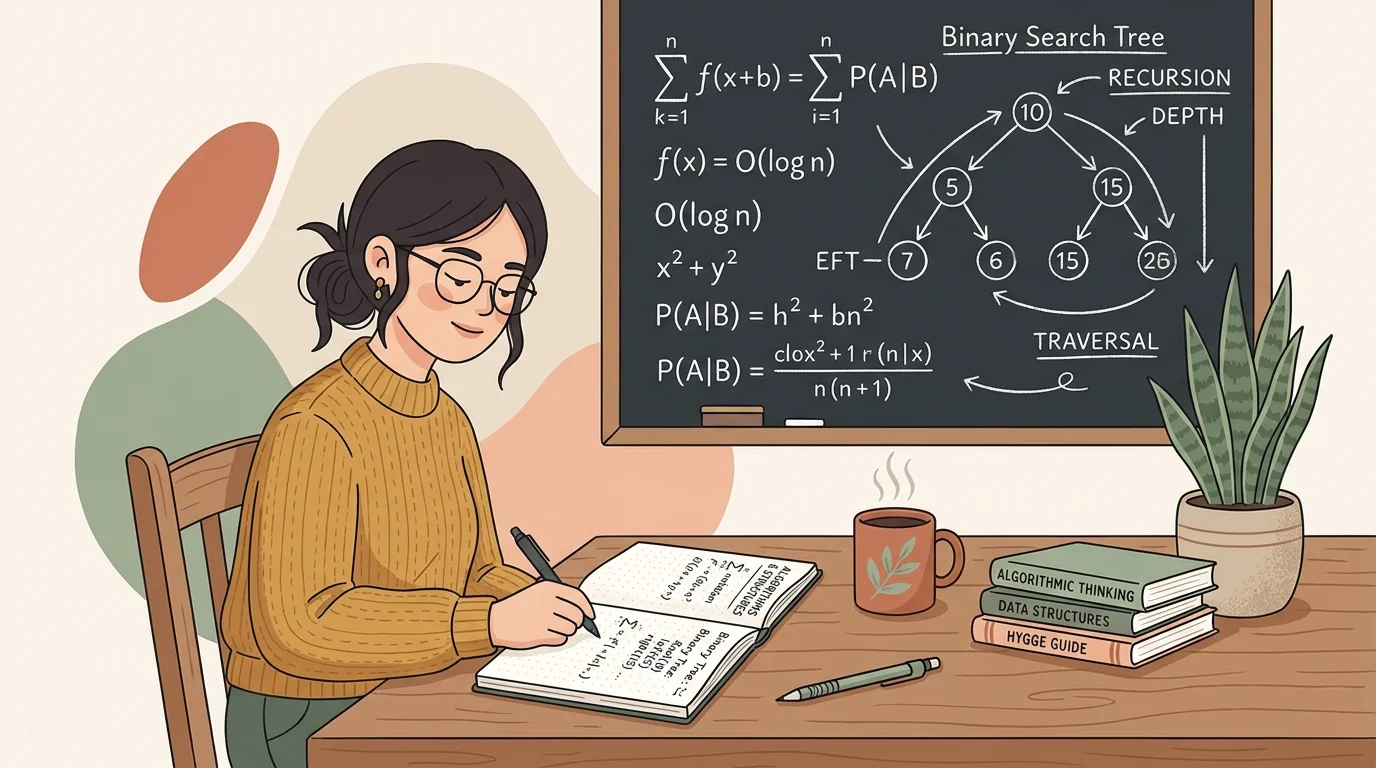
Explaining how a bicycle pump functions to a schoolchild is straightforward because the mechanism relies on intuitive physical objects: levers, chambers, and air pressure. However, when learners attempt to apply the Feynman Technique to multivariable calculus, asynchronous event loops, or quantum electrodynamics, the standard advice often falls apart. You cannot simply tell an eight-year-old about tensor fields and expect natural comprehension.
Applying the Feynman Technique to technical subjects requires a sophisticated adaptation of the classical model. The goal is never to strip away essential mathematical or algorithmic rigor; rather, it is to uncover the underlying mechanical intuition that makes abstract formulas logical in the first place. When executed properly, this adapted methodology enables professionals and ambitious students to master highly technical domains faster and with far greater retention.
Key Takeaways
Core methodologies for adapting Feynman principles to dense technical and mathematical material:
- Abstract formulas represent concrete relationships between changing quantities; always locate the physical or operational anchor.
- Replace the hypothetical child audience with an intelligent peer from an unrelated discipline to preserve technical rigor.
- Deconstruct mathematical equations term by term, translating symbolic operators into active verbal transformations.
- Document your evolving conceptual models inside a structured personal repository to track insights over time.
The Myth of Oversimplification in Technical Fields
The primary objection many technical professionals raise against the Feynman Technique is the danger of trivialization. In disciplines like distributed systems architecture, cryptography, or organic chemistry, eliminating technical terms can distort precision. If you oversimplify cryptographic hashing into “putting text into a blender,” you fail to capture essential properties like collision resistance and deterministic mapping.
Richard Feynman never advocated for sloppy approximations. In his celebrated work, The Feynman Lectures on Physics, he explained the most sophisticated quantum behaviors with pristine mathematical clarity. His genius lay in connecting abstract mathematics to verifiable physical behaviors. He did not remove the math; he gave the math an intuitive, mechanical backbone.
When adapting this method for technical domains, your goal is to identify why a formula takes its specific shape. Equations are not arbitrary rituals designed by academics to test your patience; they are compact descriptions of constraints, rates of change, and equilibrium states. Your task is to decode the story embedded within the symbols.
The Four Technical Translation Strategies
To apply Feynman principles to rigorous, dense material, deploy these four specialized translation strategies during your study sessions.
Strategy 1: Equation Deconstruction into Plain Prose
Take any mathematical formula or algorithmic function and isolate every individual variable, constant, and operator. Write an explicit prose sentence explaining what each component represents in the real world. For example, in an equation describing thermal diffusion, explain exactly what the partial derivative of temperature with respect to time represents: the speed at which a specific spot on a metal rod cools down compared to its immediate neighbors.
Strategy 2: The Intelligent Layperson Audience Shift
Instead of imagining an eight-year-old, calibrate your imaginary target audience to an intelligent software engineer, an experienced physician, or a skilled architect who knows nothing about your specific niche. This shift maintains high analytical standards while preventing you from hiding behind lazy domain jargon. You must explain the core logic with intellectual dignity and structural consistency.
Strategy 3: Extreme Value Stress-Testing
Examine how your technical model behaves when parameters approach zero, infinity, or reverse polarities. If an equation models network latency under varying server loads, test what happens when traffic drops to absolute zero or spikes toward infinity. If your conceptual model cannot describe these extreme boundaries without collapsing into mathematical absurdities, your foundational grasp requires further refinement.
Strategy 4: Visual State Diagrams and Flow Modeling
Whenever abstract logic resists simple linguistic translation, construct a visual state diagram. Sketch the system as discrete nodes connected by directional transition arrows. Annotate each arrow with the specific condition required to trigger state migration. Visualizing technical dependencies prevents memory fatigue and reveals hidden deadlocks in your conceptual thinking.
Deconstructing Dependencies Before Synthesizing
Technical disciplines are strictly hierarchical. You cannot successfully explain neural network loss gradients if you lack a firm grasp of multivariable derivatives and matrix dot products. Attempting a Feynman explanation on an advanced topic without addressing prerequisite skills leads to frustration and stall states.
Before launching into an explanation of an intricate system, map out the underlying dependency graph. Break down the master concept into distinct sub-skills and isolate each micro-component. For a proven systematic approach to ordering your learning sequence, study our guide on building skill dependency trees.
Once you establish a clear progression, drill each individual micro-mechanism until you can articulate its function without referencing external aids. To refine your deliberate practice at the micro-level, explore our actionable framework on mastering micro skills practice.
A Walkthrough Example: Deconstructing Binary Search Trees
To see this translation strategy in action, consider how a computer scientist explains a self-balancing binary search tree. A formal academic textbook defines it as a node-based data structure where each node contains a key, and left subtrees contain keys strictly less than the root while right subtrees contain keys greater than the root, maintained in balance via tree rotations.
When applying the technical Feynman method, strip away the recursive jargon and picture a telephone directory or an organized library hallway. At every doorway, you compare your target name to the label above the door. If your name comes earlier alphabetically, you walk down the left hallway; if later, down the right. At each doorway, half of the entire library is instantly eliminated from your search.
What about tree rotations? Rather than memorizing balance algorithms, describe it as redistributing books on a lopsided shelf. When the right side becomes too heavy with long branches, you lift the center book and let the left book drop down, maintaining the alphabetical order while keeping the shelf level. This physical intuition makes coding the actual pointers significantly more natural and less prone to off-by-one errors.
Archiving Technical Explanations Systematically
Because technical insights require substantial cognitive effort to produce, abandoning your explanations on scrap paper is a major strategic mistake. As you refine your plain-language descriptions and visual state diagrams, preserve them inside a centralized knowledge archive. Maintaining an accessible record allows you to review and polish your understanding as your expertise deepens.
Implementing a structured repository transforms fleeting epiphanies into permanent intellectual assets. To learn how to organize, categorize, and cross-reference your technical notes effectively, review our blueprint on the feynman notebook system.
Consistently capturing your technical translations creates a personalized reference library tailored exactly to your cognitive style. For additional evidence-based learning methodologies and tactical skill-building guides, explore the comprehensive material available on ezupskill.com.
Frequently Asked Questions
How do I handle mathematical symbols in a Feynman explanation?
Treat every symbol as a verb or a noun in a grammatical sentence. Replace abstract characters with functional descriptions of their actions. For instance, describe a summation symbol as an instruction to collect and accumulate every small contribution from a designated list of components.
What should I do if a technical topic relies heavily on code implementation?
Focus on data flow and state transformations rather than language-specific syntax. Explain how data enters the function, what logical conditions route the execution flow, and how memory or variables mutate throughout the process before writing any actual lines of code.
Can I use diagrams instead of words when practicing technical explanations?
Yes. Diagrams, flowcharts, and state machines are legitimate languages for technical explanation. The critical requirement is that you must be able to narrate the operational logic of the diagram out loud, accounting for every connection without skipping causal steps.
How much time should I invest in translating a single technical formula?
A high-value equation warrants ten to twenty minutes of focused deconstruction. Spending that focused time up front prevents dozens of hours of confusion and rote memorization during advanced project execution down the road.
Demystifying technical complexity through grounded intuition turns intimidating theoretical subjects into practical, actionable tools for lifelong self-education.