


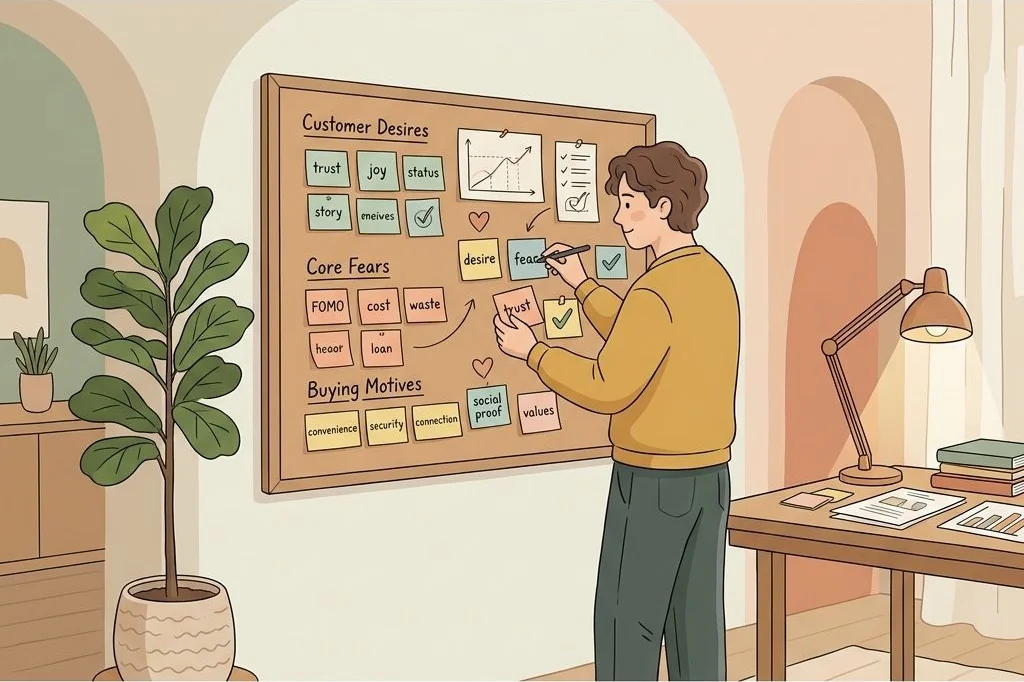
Every commercial choice that a consumer makes is fundamentally an emotional transaction disguised as an analytical evaluation. Buyers love to believe that their purchasing decisions stem from rigorous spreadsheets, feature matrices, and logical deductions. In reality, studying consumer buying psychology emotional triggers copywriting reveals that purchasing impulses ignite deep within subconscious emotional needs long before the conscious brain justifies the expense with rational logic.
When copywriters tap into foundational emotional drivers – such as the yearning for status, the craving for certainty, and the urgent desire to escape ongoing frustration – their writing ceases to be mere promotional text. It becomes an intuitive mirror reflecting the reader deepest aspirations and unvoiced challenges.
Discovering transformative communication and influence skills on EZ Upskill provides ambitious creators and leaders with practical models to master the psychological architecture of decision-making.
Key Takeaways
Core psychological insights governing how emotional triggers influence consumer buying behavior:
- Consumers make decisions based on primal emotional triggers and later rationalize their choices with logic and analytical facts.
- The core human desires for status, security, belonging, autonomy, and competence drive the majority of commercial buying behavior.
- Framing messages around pain avoidance consistently produces faster psychological action than promoting speculative future pleasure.
- Empathetic copy demonstrates profound comprehension of customer internal struggles before proposing any commercial product.
- Aligning emotional resonance with concrete logical proof constructs bulletproof sales narratives that convert skeptics into buyers.
The Dual-Engine Mind: Emotion Decides, Logic Justifies
Behavioral economists have long confirmed that human cognition operates across dual processing systems: fast, intuitive, emotional heuristics alongside slow, deliberate, analytical reasoning. When a prospective buyer lands on a sales page, their emotional faculties evaluate the proposition in milliseconds. They intuitively register whether the offer feels trustworthy, whether it aligns with their self-identity, and whether it promises immediate relief.
If that emotional ignition fails to occur, no amount of technical bullet points or price discounts will salvage the sale. However, once the emotional impulse sparks, the buyer requires analytical ammunition. They look for product specifications, warranty clauses, return policies, and feature lists – not to decide whether they want the product, but to defend their emotional desire to their spouses, business partners, or their own internal critic.
High-converting copywriting satisfies both engines simultaneously. It opens with an emotional hook that commands attention, then seamlessly transitions into structured logical evidence that removes every cognitive barrier to purchase.
| Core Emotional Driver | Subconscious Buyer Yearning | Triggering Copy Mechanism | Logical Justification Required |
|---|---|---|---|
| Status & Recognition | To be perceived as successful, elite, and competent | Exclusive framing, aspirational peer benchmarking | Measurable credentialing and industry standards |
| Pain Relief & Freedom | To eliminate persistent daily frustration and fatigue | Vivid problem agitation, empathy for struggle | Proven step-by-step methodologies and tools |
| Safety & Certainty | To avoid financial ruin, public embarrassment, or loss | Risk reversal, bulletproof ironclad guarantees | Historical case studies and verified third-party reviews |
| Autonomy & Mastery | To regain control over time, schedule, and destiny | Empowering calls to action, self-directed systems | Clear feature breakdowns and transparent pricing |
| Belonging & Identity | To feel connected with an admired tribe or community | Shared cultural values, inclusive we-oriented language | Community size metrics and active user forums |
The Five Foundational Emotional Triggers in Copywriting
While human emotion is vast and nuanced, commercial decisions are predominantly governed by five foundational psychological triggers: Status, Pain Relief, Certainty, Autonomy, and Belonging.
Status reflects an individual innate desire to be respected, admired, and viewed as competent within their professional and social circles. When copy implies that acquiring a skill or software will position the reader as an innovative leader among peers, it taps into an immensely potent motivator.
Pain relief is driven by evolutionary survival instincts. Psychological studies consistently demonstrate that humans will exert significantly more energy to avoid a current loss or escape pain than to pursue an equivalent future gain. Copy that articulates the hidden cost of daily friction strikes a responsive chord that demands immediate resolution.
Certainty counters the universal fear of the unknown. When customers hesitate, it is rarely because they dislike the product; it is because they fear regret. Providing comprehensive warranties and transparent onboarding workflows satisfies this emotional hunger for safety.
Autonomy appeals to our deep longing for self-determination. People despise feeling micromanaged or trapped by outdated tools. Positioning your offer as a vehicle for personal liberation resonates powerfully with ambitious professionals.
Finally, belonging appeals to social connection. Communicating that joining your program connects the reader with a curated community of forward-thinking peers transforms a solitary purchase into a badge of collective identity, building on frameworks covered in Cialdini unity principle and shared identity.
Mapping Emotional Triggers to Customer Awareness Stages
Not every prospective customer enters your sales environment with the same degree of awareness. Calibrating which emotional triggers to emphasize depends on the customer mental state. Legendary marketing strategist Eugene Schwartz identified five distinct awareness levels: Unaware, Problem Aware, Solution Aware, Product Aware, and Most Aware.
For problem-aware readers, pain relief and empathy are your primary levers. These readers feel the symptom acutely – such as struggling with low conversion rates – but do not yet know that direct response copywriting is the remedy. Opening with technical product features will lose them immediately. Instead, describe their daily frustration in vivid, respectful detail.
For product-aware prospects who already understand your offer, switch the emotional emphasis toward certainty, status, and urgency. These readers are comparing options and questioning whether your specific program will work for them. Reassurance, proof, and risk reversal become the decisive elements that seal the commitment.
Techniques for diagnosing customer perspective and disarming underlying skepticism align with our guide on the accusation audit technique in communication.
Ethical Persuasion vs Manipulative Pressure
Harnessing emotional triggers carries an essential ethical responsibility. Manipulative copy fabricates artificial panic, exploits vulnerabilities with false claims, or bullies prospects with manufactured guilt. While manipulative tactics may produce short-term clicks, they create high refund rates, chargebacks, and permanent reputational damage.
Ethical direct response, by contrast, operates on empathetic alignment. It illuminates genuine problems that exist in the prospect life and offers a legitimate, battle-tested solution. By telling the absolute truth about what your product can and cannot do, you build lasting customer goodwill and long-term lifetime value.
Cognitive research documented in the Association for Psychological Science decision-making publications confirms that transparency and authentic empathy establish deeper neural trust than high-pressure sales tactics.
Mastering the balance between assertive influence and respectful collaboration is explored further in our companion piece on calibrated questions in strategic discussions.
Frequently Asked Questions
Why do emotions play such a dominant role in purchasing decisions?
Neuroscience demonstrates that human choices originate in the emotional limbic system; logic only steps in afterward to justify decisions with rational explanations and facts.
What are the most powerful emotional triggers in copywriting?
Key emotional triggers include the desire for social status, fear of missing out, longing for relief from ongoing pain, need for security, and aspiration for personal autonomy.
How do you avoid sounding manipulative when using emotional triggers?
Focus on authentic empathy and ethical alignment: highlight genuine problems your product genuinely solves, rather than manufacturing artificial anxiety or false promises.
How should logical proof be balanced against emotional appeals?
Use emotional triggers in headlines and hooks to capture immediate attention, then provide rigorous data, guarantees, and case evidence in the body copy to satisfy rational scrutiny.
Mastering consumer buying psychology emotional triggers copywriting turns static sales pages into engaging, persuasive conversations. By respecting the emotional foundations of human decision-making and providing unassailable logical proof, ambitious professionals build enduring commercial relationships grounded in genuine mutual value.