


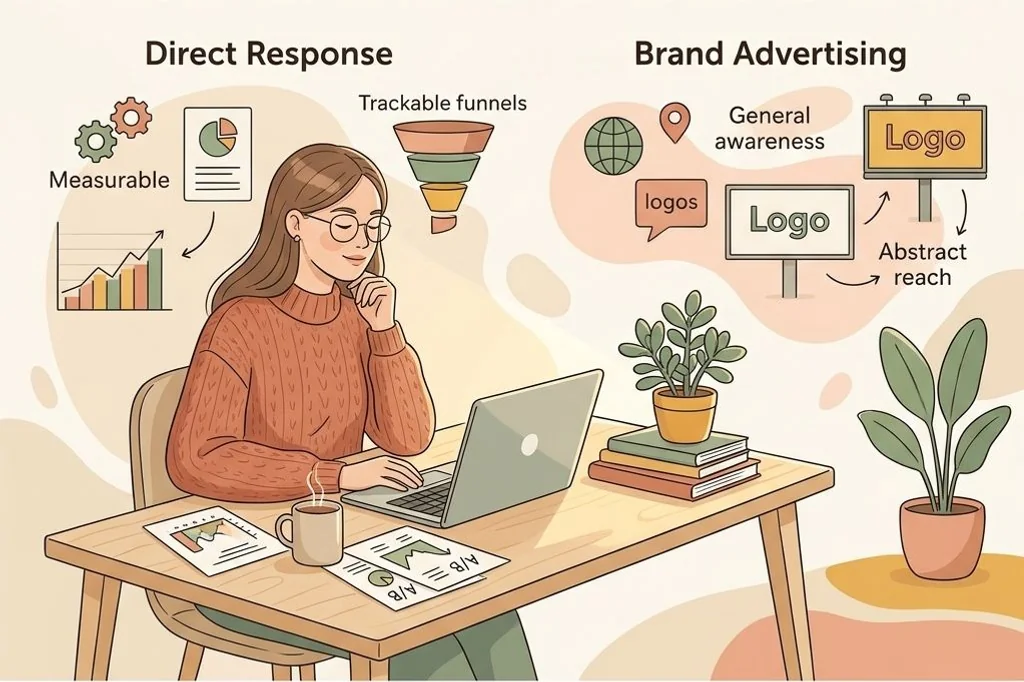
Modern businesses constantly navigate a fundamental strategic dilemma: should marketing budgets fund creative awareness campaigns or produce accountable sales messages? Navigating direct response copywriting vs brand advertising reveals two diametrically opposed philosophies of human motivation. While brand marketing attempts to build broad corporate familiarity, direct response focuses on guiding the prospect toward an immediate, measurable buying decision.
Every commercial transaction originates from human psychology. When copywriters understand why people buy, they stop relying on vague slogans and begin engineering persuasive sales arguments that systematically dismantle hesitation, clarify value, and invite decisive action.
Exploring foundational communication mastery on EZ Upskill equips creators, entrepreneurs, and ambitious professionals with practical frameworks to convert written words into tangible career and business momentum.
Key Takeaways
Core strategic distinctions and psychological principles separating direct response from brand advertising:
- Direct-response copywriting demands an immediate, trackable action, while brand advertising seeks long-term memory recall and ambient brand sentiment.
- Accountability defines direct response: every dollar spent must produce a measurable return in leads, phone calls, or completed purchases.
- Emotional resonance and psychological drivers trigger conversion; clever wordplay and abstract imagery rarely prompt immediate consumer spending.
- Direct response functions as a scientific conversation between a brand and an individual, utilizing tailored sales arguments to overcome specific objections.
- Mastering the structural psychology of direct response builds predictable business revenue without relying on massive media awareness budgets.
Defining the Core Divide: Direct Response Copywriting vs Brand Advertising
Brand advertising is built on repetition and passive recognition. Think of billboards along busy highways, celebrity endorsements, or entertaining television commercials during major sporting events. The primary objective is to occupy mental real estate so that when a consumer visits a supermarket months later, they instinctively reach for a familiar soda bottle or detergent package. Success is measured through subjective brand recall surveys, impressions, and generalized reach.
In stark contrast, direct-response copywriting is salesmanship in print. It does not entertain for the sake of entertainment; it asks for a decision right now. Whether embedded in a sales page, an email sequence, or a physical catalog, every direct response asset contains a clear hook, an educational case for value, and a specific call to action with a trackable response mechanism.
For independent creators and growing enterprises, direct response is the indispensable survival engine. It does not require millions of dollars in sustained billboard media to function. When constructed with rigorous behavioral psychology, a single direct response promotion can generate immediate revenue, fund customer acquisition costs, and provide definitive feedback on offer appeal within hours.
| Operational Dimension | Direct-Response Copywriting | Traditional Brand Advertising |
|---|---|---|
| Primary Objective | Immediate, measurable behavioral response | Long-term sentiment and mental brand recall |
| Target Audience | Specific individuals experiencing an acute pain point | Broad demographic masses across media channels |
| Measurement Metric | Cost per acquisition, conversion rate, cash return | Gross impressions, reach, brand sentiment score |
| Copywriting Style | Conversational, evidence-driven, educational salesmanship | Clever, conceptual, slogan-heavy, aesthetically polished |
| Call to Action | Explicit, singular, trackable next step | Diffuse, ambiguous, or entirely absent |
| Financial Feedback | Immediate and mathematically auditable | Delayed, indirect, and difficult to isolate |
The Psychology of Accountability: Why Direct Response Works
Why does direct response consistently outperform clever branding when budgets are finite? The secret lies in behavioral accountability. Direct response treats the reader not as an audience member admiring a performance, but as a prospective partner evaluating an exchange of value.
Human beings rarely make consequential purchase decisions based solely on artistic aesthetic admiration. When people spend money, they part with accumulated labor, security, and time. That emotional friction demands reassurance. Direct response addresses this friction directly by presenting verifiable proof, customer endorsements, explicit guarantees, and step-by-step demonstrations.
Understanding these subtle interpersonal dynamics mirrors principles explored in our analysis of pre-suasion and strategic priming in presentations, where laying the groundwork before the pitch dictates the final decision.
The Anatomy of a High-Performing Direct Response Asset
While brand ads rely on minimalist slogans, direct response assets adhere to a proven structural architecture designed to guide the reader through an emotional and logical sequence.
First comes the Hook: a compelling headline that calls out the target reader and articulates an immediate curiosity or urgent problem. Second is the Agitation: exploring the painful consequences of inaction, showing empathy for the reader daily frustration without being condescending.
Third is the Solution: introducing the product or service as the natural mechanism that eliminates the problem. Fourth is the Evidence: marshaling testimonials, case data, and credentials to substantiate every claim. Fifth is the Offer: bundling bonuses, detailing value, and introducing risk reversal through generous guarantees. Finally, the Call to Action provides unambiguous instructions on how to complete the transaction immediately.
By following this cognitive sequence, direct response aligns with human decision-making patterns, guiding the reader from initial skepticism to enthusiastic conviction.
Integrating Educational Value into Direct Response Copy
Modern direct response is far removed from the loud, aggressive infomercials of previous decades. Discerning consumers easily detect manipulative pressure and immediately leave. Today, the most effective direct response copy functions as educational consulting.
By providing genuine insights, diagnostic rubrics, and mindset shifts inside the copy itself, the writer establishes immense authority. When a reader learns something valuable simply by reading your sales letter, they naturally conclude that your paid product must be extraordinary. This principle of reciprocal value transforms copy from a pushy pitch into a welcoming invitation to personal growth.
Techniques documented by the American Psychological Association behavioral decision resources affirm that educational framing drastically lowers defensive resistance during complex choices.
Building genuine trust before making a request connects deeply with the interpersonal empathy methods detailed in our guide on tactical empathy in negotiation.
Transitioning from Passive Awareness to Measurable Conversion
How can businesses shift their content creation from passive brand publishing toward direct response rigor? The transition begins by reviewing every published piece of content with a single question: What specific action should the reader take next?
If an article concludes with vague platitudes, it remains passive brand advertising. If that same article invites the reader to test their understanding through a free checklist, join a focused masterclass, or purchase a tactical guide, it becomes direct response. Adding clear calls to action, tracking response rates, and iteratively testing headlines transforms ordinary communication into a reliable business asset.
Learning how to systematically label emotional barriers and address objections builds on the strategies shared in emotion labeling in communication.
Frequently Asked Questions
Is direct response copywriting only useful for sales pages?
No. Direct response principles apply to email newsletters, social media posts, webinar invitations, hiring descriptions, and internal company proposals that require a clear decision.
Does direct response copywriting require long-form text?
Not necessarily. Direct response copy should be as long as required to present the argument, dismantle objections, and present the offer, whether that takes three hundred words or three thousand words.
Can brand advertisers benefit from direct response techniques?
Absolutely. Major global brands increasingly incorporate direct response elements – such as QR codes, personalized digital quizzes, and clear calls to action – to measure campaign effectiveness.
What is the most critical element of a direct response sales letter?
The headline and the opening hook are the most vital components; if they fail to arrest attention and resonate with reader desires, the remainder of the copy goes completely unread.
Understanding the fundamental distinction between direct response copywriting vs brand advertising transforms how organizations communicate. By grounding messaging in behavioral psychology, measurable feedback, and unambiguous calls to action, ambitious professionals turn written copy into an engine of predictable, sustainable growth.